A Persian miniature is a small painting, whether a book illustration or a separate work of art intended to be kept in an album of such works. The techniques are broadly comparable to the Western and Byzantine traditions of miniatures in illuminated manuscripts, which probably had an influence on the origins of the Persian tradition. Although there is an equally well-established Persian tradition of wall-painting, the survival rate and state of preservation of miniatures is better, and miniatures are much the best-known form of Persian painting in the West. Miniature painting became a significant Persian form in the 13th century, and the highest point in the tradition was reached in the 15th and 16th centuries. The tradition continued, under some Western influence, after this, and has many modern exponents. The Persian miniature was the dominant influence on other Islamic miniature traditions, principally the Ottoman miniature in Turkey, and the Mughal miniature in the Indian sub-continent.
Tuesday, September 23, 2008
PERSIAN MINIATURE

POINTILLISM
Pointillism is a style of painting in which small distinct points of primary colors create the impression of a wide selection of secondary and intermediate colors. The technique relies on the perceptive ability of the eye and mind of the viewer to mix the color spots into a fuller range of tones and is related closely to Divisionism, a more technical variant of the method. It is a style with few serious practitioners and is notably seen in the works ofSeurat, Signac and Cross. The term Pointillism was first coined by art critics in the late 1880s to ridicule the works of these artists and is now used without its earlier mocking connotation. The practice of Pointillism is in sharp contrast to the more common methods of blending pigments on a palette or using the many commercially available premixed colors. Pointillism is analogous to the four-color CMYK printing process used by some color printers and large presses, and to a lesser degree to computer monitors and television sets which use tiny dots of primary red, green, and blue to render color.

PRIMITIVE
Primitive art is characterized by a childlike simplicity. (See also outsider art, to which it bears many similarities.) It is a gross oversimplification to assume that Naïve art is created by people with little or no formal art training. The term naïve art presumes the existence (by contrast) of an academy and of a generally accepted educated manner of art creation, most often painting. In practice, however, there are schools of naïve artists. Over time it has become an acceptable style. The characteristics of naïve art are an awkward relationship to the formal qualities of painting. Difficulties with drawing and perspective that result in a charmingly awkward and often refreshing vision, strong use of pattern, unrefined color, and simplicity rather than subtlety are all supposed markers of naïve art. It has, however, become such a popular and recognizable style that many examples could be called pseudo-naïve. Whereas naïve art ideally describes the work of an artist who did not receive a formal education in an art school or academy, for example Henri Rousseau or Alfred Wallis, 'pseudo naïve' or 'faux naïve' art describes the work of an artist working in a more imitative or self-conscious mode and whose work can be seen as more imitative than original. Primitive art is another term often applied to the art of those without formal training. This is distinguished from the self-conscious movement primitivism. Another term related to (but not completely synonymous with) naïve art is folk art.

REGIONALISM
Regionalism is a realist modern American art movement that was popular during the 1930s. The artistic focus was from artists who shunned the city life and rapidly developing technological advances to create scenes of rural life. Regionalist style was at its height from 1930 to 1935, and is best-known through the so-called "Regionalist Triumvirate" of Grant Wood in Iowa, Thomas Hart Benton in Missouri, and John Steuart Curry inKansas. During the Great Depression of the 1930s, Regionalist art was widely appreciated for its reassuring images of the American heartland.

ROCOCO
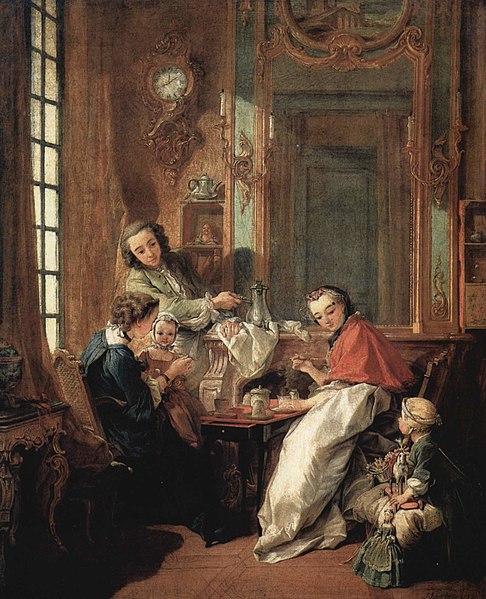
Rococo is a style of 18th century French art and interior design. Rococo rooms were designed as total works of art with elegant and ornate furniture, small sculptures, ornamental mirrors, and tapestry complementing architecture, reliefs, and wall paintings. It was largely supplanted by the Neoclassic style.
ROMANTICISM
Romanticism is a complex artistic, literary, and intellectual movement that originated in the second half of the 18th century in Western Europe, and gained strength during the Industrial Revolution.[1] It was partly a revolt against aristocratic social and political norms of the Age of Enlightenment and a reaction against the scientific rationalization of nature, and was embodied most strongly in the visual arts, music, and literature. The movement stressed strong emotion as a source of aesthetic experience, placing new emphasis on such emotions astrepidation, horror and awe—especially that which is experienced in confronting the sublimity of untamed nature and itspicturesque qualities, both new aesthetic categories. It elevated folk art and custom to something noble, and argued for a "natural" epistemology of human activities as conditioned by nature in the form of language, custom and usage. Our modern sense of a romantic character is sometimes based on Byronic or Romantic ideals. Romanticism reached beyond the rational and Classicist ideal models to elevate medievalism and elements of art and narrative perceived to be authentically medieval, in an attempt to escape the confines of population growth, urban sprawl and industrialism, and it also attempted to embrace the exotic, unfamiliar and distant in modes more authentic than chinoiserie, harnessing the power of the imagination to envision and to escape.

SOCIALIST REALISM
Socialist realism is a teleologically-oriented style of realistic art which has as its purpose the furtherance of the goals ofsocialism and communism. Although related, it should not be confused with social realism, a type of art that realistically depicts subjects of social concern.
